
Peak Collection
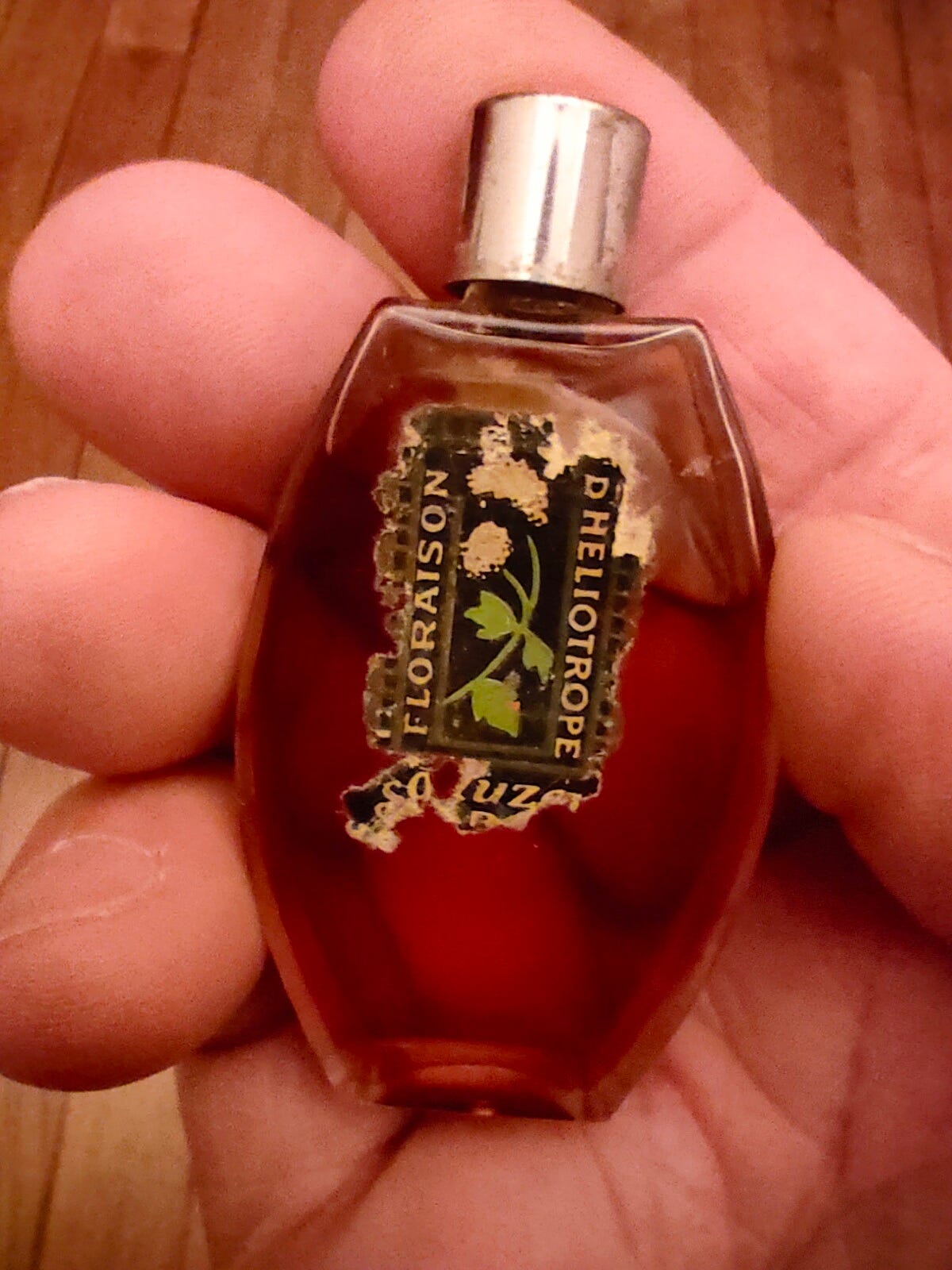
The flea markets of Paris were a goldmine of perfume. Samples of all ages could be found at cheap prices; miniatures, vials, carded samples, many rare and precious things in a variety of styles and eras: Nombre Noir, Crêpe de Chine, Le Feu d’Issey, all bought for little money…
At first they were exciting days of discovery. Amazing things would turn up like pearls in the mud. But over time rarities became harder to find, and just the same ordinary things would appear again and again.
After Covid the market became more expensive – in line with prices in the shops. More and more time and money was needed, for less and less return; it began to look like a waste of time. And then, one day, I bought a vintage ‘sent bon’ just to get a discount on two other mini’s. Afterwards, as I sniffed it, I said to myself ‘That’s it; I’m done with collecting – it’s Peak Collection’.
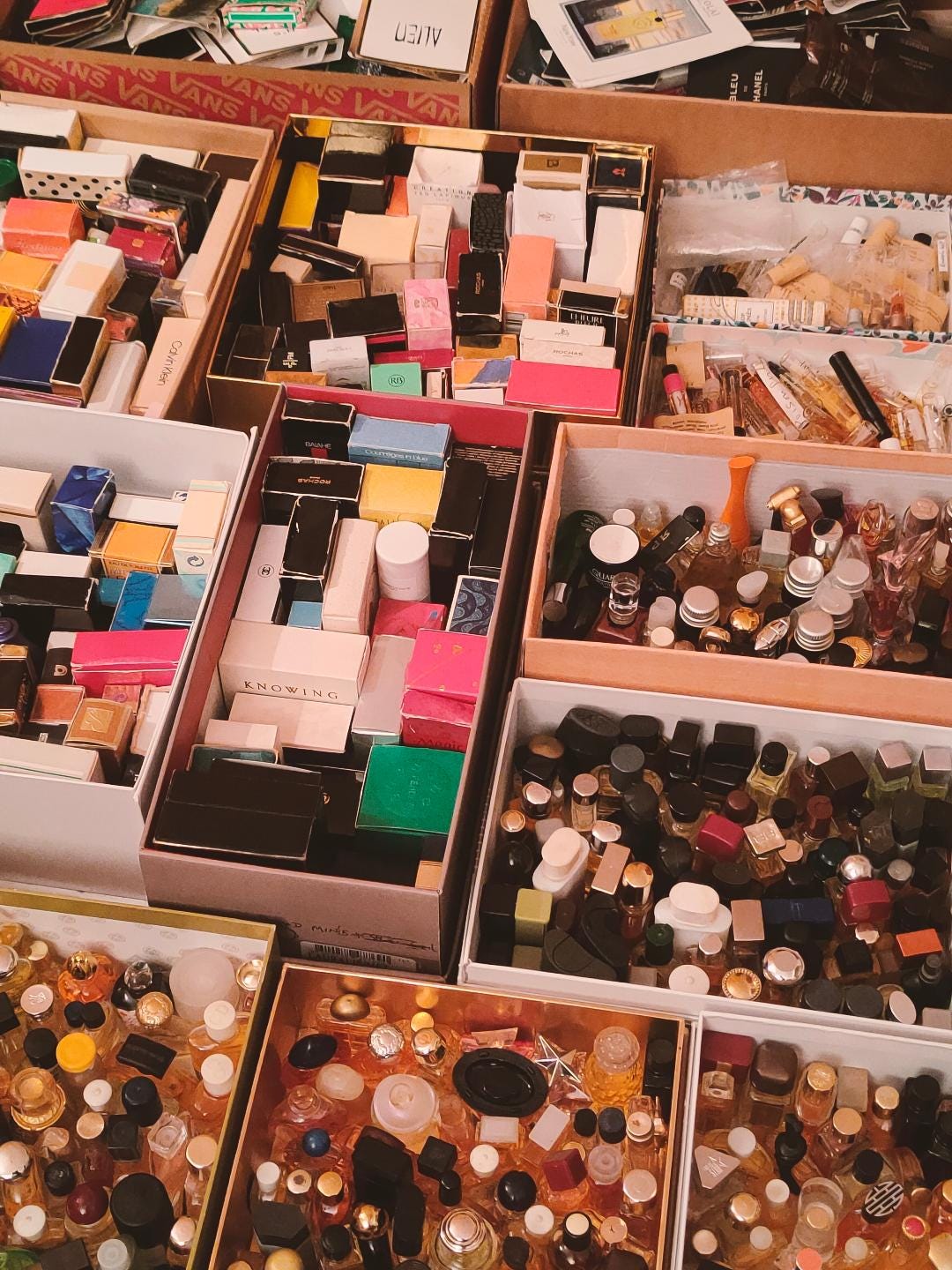
And just as well… For too long my eyes were bigger than my nose. More samples came in than could be sniffed, and a huge backlog built up. The collection became unwieldy, sometimes it would take an hour to find one sample. I had to spend time organizing, and maintaining the collection, and not actually using it. It was becoming a drain on my time.
Not only was the collection becoming a problem, my circumstances had changed. What was an asset began to seem like a liability. Something had to change; it was time to divide the sheep from the goats.
The weeding out began small, and casually. Tiny samples, too small to wear were thrown out. And then, as it picked up steam, the worst of the bottles were ditched. Once the ball started rolling, it led to a more structured approach. The collection now became for using; it would be more of a resource and less of a reference.
~~~ ~~~ ~~~
Under this new regime, samples are split into three categories.
The first one is the dross – only fit for the bin. Other things, which aren’t quite so bad can go for air care in the toilet. Some of them were good once, but went off with time. Some were clearly rubbish from the start.
Badly composed, cheap materials, poor ideas; any of these are enough to consign a perfume to the bin.
There are samples which are not that bad, but not that good, and they are given away, or left in the street – on a bench, or a windowsill; anywhere and everywhere.
The next category is the greats; the classics, the rarities and the true loves. These things – which can’t be done without – are easily dealt with. They go back in the box, along with the favorites, the staples, the interesting quirky and nice things – which appeal, and don’t offend. They can all stay.
The problem comes with the stuff in between; the things I wouldn’t wear, but are still nice in some way – or interesting. Or things I want to sniff now and again.
The banal, the copies, the imperfect things with moments of class – but which are unexceptional, these can be hard calls to make. Should they stay or should they go?
And then there are the decent scents that are my style – and quite good – but they’re not outstanding. They get finished up in short order.
This is very personal of course; it’s now a case of taste, and less being ‘objective’.
Shortly after the culling started, I happened to read Erich Fromm, a psychoanalyst and member of the Frankfurt school of social theory. In his book To Have or to Be? he examines how we live our lives in a world that puts more emphasis on having, and less on being.
Very soon, by the end of chapter one, it was clear that I was seeing my collection through the having mindset, which Fromm describes in his book.
To illustrate this having mindset, he writes about students who go to a lecture and write down everything the professor says. The words and ideas in the lecture (which are those of the prof or other some other outside authority) are noted down and kept by the student, ready for the time when the words and ideas have to be memorized, and regurgitated, in order to pass the exam at the end of the course.
The students have the words and ideas but, Fromm says, they keep them as some remote knowledge, not really thinking about them and combining them with their own ideas. What the students take from the lecture doesn’t change their intellectual being, it is just more intellectual stuff that they have.
Fromm then compares these having students with another type of student, who takes ‘conspicuously few notes’. They don’t need to take notes because they’ve previously read around the subject and internalized the ideas they’ve encountered. When these students hear the new words and ideas in the lecture, they compare them to the framework of ideas they’ve got in their minds already. Unlike the having student, the being student doesn’t need to file away reams of notes, because they are absorbing the ideas directly into their understanding.
~~~ ~~~ ~~~
I was the having student. I wasn’t going to lectures on perfume history, but I was scouring flea markets for the perfume ‘words and ideas of outside authorities’, which I would then then file away against some future time when I might have to ‘pass an exam’ (eg: review a pong, or compare different perfumes, etc).
Every student needs a library, and ‘my own personal osmothèque’ was mine, (osmothèque means library of perfumes, nothing more). But my collection wasn’t just a library, it was also a prop to support my new persona as Bibi the Parfumista.
~~~ ~~~ ~~~
Just like a shop keeper has control of a shop and the wares in it, I have my collection. But, unfortunately, there are some perfumes in it that I don’t have any understanding of, or emotional connection to. So, even though they belong to me, I am not their ‘guardian’.
A true guardian of a perfume (in the sense of being someone who is a loving parent) is one who has been moved by the perfume’s beauty, its faults, its banalities; someone who understands what it’s saying and appreciates it.
Reading Fromm was a flash of insight. It crystallized an intuition : I have many perfumes, but I am not connecting with them.
~~~ ~~~ ~~~
As it stands, there are perfumes in my collection that are just dead weight; dumb artifacts in a private museum that no one visits.
They deserve better.
Their stories should be heard.
A very brief summary of the hoarding phenomenon, which is behind all types of collecting. Buying and hoarding stuff is also a primary mode of the capitalist system, which we are all subject to (except for perfume lovers in North Korea - if there are any.)
https://en.wikipedia.org/wiki/Character_orientation
You’ve captured the essence of the collector’s “struggle” perfectly- at least for this collector! Off to read Fromme… perhaps will only “have” his ideas but in time, hopefully, I’ll internalize them.